
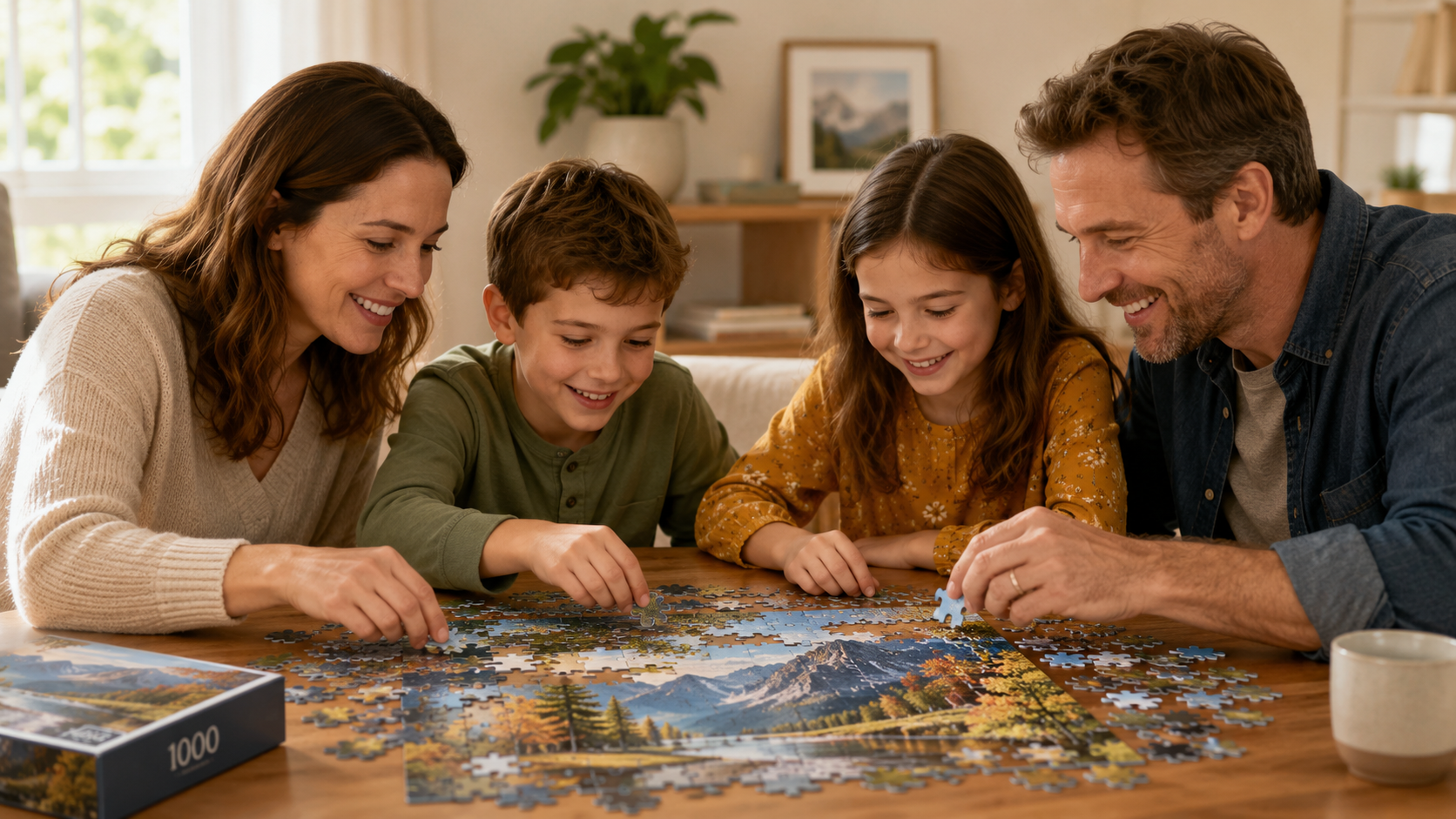
Jigsaw puzzles may seem like a simple pastime.
You spread the pieces on a table. You turn them right side up. You look for the edges. You sort by color, shape, pattern, or whatever system makes sense to you. Then, piece by piece, the picture begins to come together.
But puzzles are more than something to do on a rainy afternoon.
They can be good for your mind, good for your mood, and good for your relationships. They give your brain something useful to do without the pressure of a deadline, a score, or a screen. They can be enjoyed alone, but they can also bring people together in a quiet, low-pressure way.
That combination is part of what makes them so valuable.
When you work a jigsaw puzzle, your brain is active. You are looking at shapes, colors, patterns, and tiny details. You are remembering where you saw a certain shade of blue or a piece with a bit of lettering or a curved line. You are comparing, testing, adjusting, and trying again.
That’s problem-solving.
It doesn’t feel like a formal mental exercise, but it is still exercise. You are using visual recognition, memory, concentration, spatial reasoning, and patience. You are training yourself to notice details and think through possibilities.
Puzzles also encourage persistence.
Not every piece fits the first place you try it. Sometimes the one you are sure belongs in a certain spot does not belong there at all. Sometimes you have to leave a section alone and come back to it later. Sometimes progress is slow.
That can be frustrating, but it can also be good for us.
In a world where we are used to quick answers and instant results, puzzles ask us to slow down. They remind us that some things come together gradually. A puzzle does not reward rushing. It rewards attention, patience, and steady effort.
Puzzles can also be calming.
There is something peaceful about sorting pieces and looking for connections. Your mind has a clear task. Your hands are busy. The next step is small and manageable. You are not trying to solve all the problems in your life. You are trying to find the piece that completes the corner of the barn, the edge of the lake, or the eye of the dog.
For a little while, that may be enough.
That doesn’t mean puzzles make stress disappear. They do not. But they can give your mind a break from noise, worry, and constant stimulation. They can create a small area of order when the rest of life feels busy or scattered.
They are also a good screen-free activity.
Most of us spend plenty of time with phones, computers, tablets, and televisions. Some of that time is necessary. Some of it is useful. Some of it is simply habit.
A jigsaw puzzle gives us another option.
It gives us something to do in the evening besides scrolling. It gives families something to gather around that does not require everyone to stare at a separate device. It gives guests something casual to join. It gives children, parents, grandparents, and friends a shared activity that does not depend on technology.
That brings us to one of the best benefits of puzzles: connection.
A puzzle can be worked alone, and many people enjoy that. But it can also be worked with others. People can drift in and out. One person may be good at finding edge pieces. Another may see color patterns quickly. Someone else may not want to sit for long but still enjoys placing a few pieces whenever they pass the table.
There’s no need for everyone to participate the same way.
That’s part of the charm.
Unlike many games, a puzzle is not competitive. There is no winner and loser. No one has to keep score. Everyone is working toward the same goal. That makes puzzles a good activity for family visits, holidays, quiet evenings, church groups, senior gatherings, vacation homes, waiting areas, or any setting where people may want something to do while they talk.
Sometimes the conversation is the point.
A puzzle gives people a reason to stay near each other without forcing constant conversation. You can talk while you work. You can sit quietly together. You can laugh over a piece that everyone has tried in the same wrong spot. You can celebrate when someone finally finds the missing section that has been bothering everyone.
Those small moments are precious.
Puzzles can also prompt memories and stories, especially when the image has personal meaning.
That is why custom jigsaw puzzles can make such thoughtful gifts.
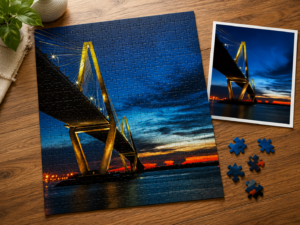
A favorite photograph can become more than an image—it can become an activity, a gift, and a memory.
Many people do not realize that a favorite photograph can be turned into a puzzle. It might be a family photo, a wedding picture, a favorite pet, a vacation scene, a special event, or a place that holds meaning. Instead of keeping the photo only in a frame or on a phone, you can turn it into an activity people can enjoy together.
A custom puzzle can be especially meaningful for grandparents, families, reunions, anniversaries, birthdays, Christmas gifts, or housewarming gifts. It’s personal without being complicated. It’s useful without being ordinary. And when people work the puzzle, they’re not just putting pieces together. They are remembering the story behind the image.
Jerry Clement’s photographs can also be ordered as jigsaw puzzles.
If you see one of his images in the gallery on our website—a landscape, wildlife photo, travel image, or another scene you especially enjoy—we can have it made into a puzzle for you or for someone on your gift list. Click here to browse.
That gives you the beauty of the photograph and the enjoyment of the puzzle.
Jigsaw puzzles are simple, but simple things can still do a lot of good. They can help us slow down, focus, think, remember, relax, and connect. They can give our hands something peaceful to do and our minds something constructive to work on.
And sometimes, piece by piece, they give us more than a finished picture.
